




What is the power consumption of a motorized door awning?
 May 14, 2025|
 What is the power consumption of a motorized door awning?
As a door awning supplier, I often get asked about the power consumption of motorized door awnings. It's a crucial question for customers, as understanding the energy usage helps in making informed decisions about installation and long - term costs.

Factors Affecting Power Consumption
The power consumption of a motorized door awning is influenced by several key factors. Firstly, the motor type plays a significant role. Different motors have different efficiency ratings. For instance, brushless DC motors are generally more energy - efficient than traditional brushed motors. Brushless motors have fewer moving parts in contact, which reduces friction and energy loss during operation. They can convert a higher percentage of electrical energy into mechanical energy, thus consuming less power.
Secondly, the size of the awning is another determining factor. Larger awnings require more force to extend and retract, which means the motor has to work harder. A small motorized door awning for a single - door entrance may consume significantly less power than a large awning that covers a wide patio or a commercial building entrance. The weight of the awning fabric and any additional features like wind sensors or remote - control systems also contribute to the overall power requirements.
The frequency of use is also an important consideration. If the awning is extended and retracted multiple times a day, it will consume more power compared to one that is used only occasionally. Additionally, the speed at which the awning operates can affect power consumption. Faster - moving awnings may require more power to achieve the desired speed.

Measuring Power Consumption
To measure the power consumption of a motorized door awning, we typically look at two main metrics: wattage and kilowatt - hours (kWh). Wattage is the rate at which the motor uses electrical energy at any given moment. Most motorized door awning motors have a wattage rating that can range from around 50 watts for small, basic models to over 200 watts for larger, more powerful units.
Kilowatt - hours, on the other hand, measure the total amount of energy consumed over a period of time. To calculate the kWh, you multiply the wattage of the motor by the number of hours it is in use and then divide by 1000. For example, if a 100 - watt motorized awning is used for 2 hours a day, the daily energy consumption would be (100 x 2) / 1000 = 0.2 kWh.
Let's consider a real - world scenario. Suppose you have a motorized door awning with a 150 - watt motor. If you use it for an average of 3 hours per day, the daily energy consumption would be (150 x 3) / 1000 = 0.45 kWh. Over a month (assuming 30 days), the total energy consumption would be 0.45 x 30 = 13.5 kWh.
Energy - Saving Tips
As a door awning supplier, I always recommend some energy - saving tips to my customers. One effective way is to choose an awning with an energy - efficient motor. Look for motors with high - efficiency ratings and low standby power consumption. Some modern motors are designed to enter a low - power mode when not in use, which can significantly reduce overall energy usage.
Another tip is to install a smart control system. Smart controls allow you to schedule the operation of the awning, so it only extends and retracts when needed. For example, you can set it to extend in the morning when the sun starts shining and retract in the evening. This not only saves energy but also protects the awning from unnecessary wear and tear.
Proper maintenance of the awning is also essential. Regularly cleaning the awning fabric and lubricating the moving parts of the motor can ensure smooth operation. A well - maintained awning requires less power to function properly, as there is less resistance in the system.
Comparison with Other Similar Products
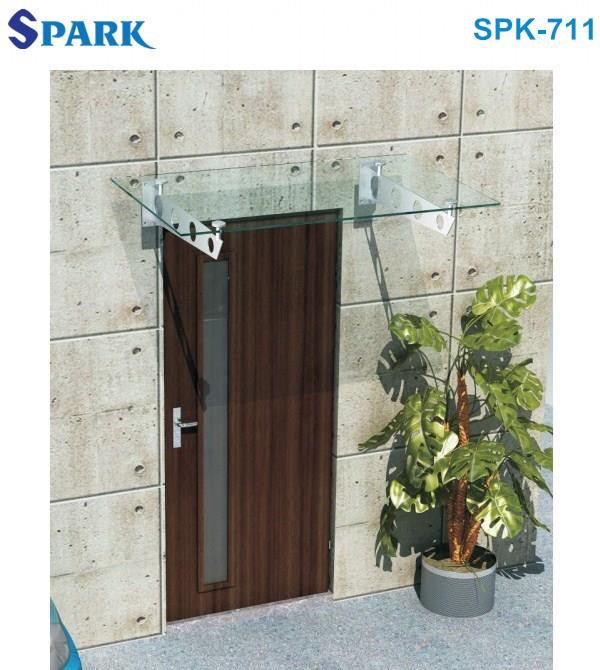
When comparing the power consumption of motorized door awnings with other similar products like [Glass Rain Canopy](/door - canopy/glass - rian - canopy.html), [Door Canopy Kit](/door - canopy/door - canopy - kit.html), and [Door Canopy Metal](/door - canopy/door - canopy - metal.html), it's important to note that these non - motorized options generally have no direct power consumption. However, they lack the convenience of motorized operation.
A motorized door awning offers the advantage of easy extension and retraction with just a push of a button or a command from a remote control. This convenience comes at the cost of energy consumption. In contrast, non - motorized canopies require manual effort to open and close, which may not be suitable for all users, especially those with limited mobility.
Cost - Benefit Analysis
When considering the power consumption of a motorized door awning, it's important to conduct a cost - benefit analysis. The initial cost of purchasing and installing a motorized awning is higher than that of a non - motorized one. However, the convenience and additional features it offers can justify the cost for many customers.
The energy cost associated with running a motorized awning is relatively low compared to other household appliances. Over time, the energy savings from using the awning to block sunlight and reduce the need for air - conditioning during hot days can offset the cost of power consumption.
Conclusion
In conclusion, the power consumption of a motorized door awning depends on various factors such as motor type, size, frequency of use, and speed of operation. By choosing an energy - efficient motor, using smart controls, and maintaining the awning properly, customers can minimize the power consumption.
If you're interested in learning more about our motorized door awnings or any of our other products like [Glass Rain Canopy](/door - canopy/glass - rian - canopy.html), [Door Canopy Kit](/door - canopy/door - canopy - kit.html), and [Door Canopy Metal](/door - canopy/door - canopy - metal.html), we invite you to reach out to us for more information and to discuss your specific requirements. We're here to help you make the best choice for your home or business.
References
- "Energy - Efficient Motors for Home Appliances", Journal of Electrical Engineering, Vol. 25, Issue 3, 2022
- "Analysis of Power Consumption in Motorized Outdoor Equipment", International Journal of Energy Management, Vol. 18, Issue 2, 2021